🩺 Skim This (For Busy Nurses)
Short on time? Here’s what matters:
- Feeling overwhelmed, anxious, or emotional as a new nurse is common
- The current healthcare environment is more demanding than ever before
- Unsafe staffing, shorter orientations, and higher patient acuity are real challenges
- Struggling does not mean you’re failing, it means the system is strained
- “Make it to one year” is not always the right advice for every situation
- Growth comes from support and learning, not just time on the job
- Many new nurses are forced into survival mode instead of real learning
- Leaving or changing roles can be a smart, self-protective decision
- You are allowed to prioritize your health, safety, and long-term career
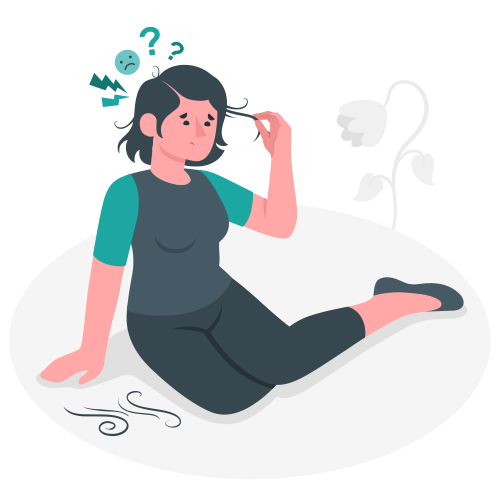
You’ve been a nurse for less than a year, and some days, you just want to cry.
Maybe it’s in your car after a shift.
Maybe it’s in the shower, trying to wash the day off.
Maybe it’s before work, staring at your badge and wondering how you’re supposed to do this again.
The anxiety before your shift, the exhaustion after, the constant feeling that you’re one mistake away from failing, it’s heavy. And when you look around, it feels like everyone else is handling it better than you are.
Let us say this clearly, right from the start:
You are not alone. And you are not weak.
What you’re feeling is a completely normal response to an abnormal situation. The modern healthcare system is actively breaking new nurses, and it’s not your fault.
Being a New Nurse Has Always Been Hard, But This Is Different
Nursing has never been an easy profession. Even the most seasoned nurses will tell you that their first year (or two) felt overwhelming. There’s a steep learning curve, a lot of responsibility, and very little room for error. That part isn’t new.
What is new is the environment new nurses are being dropped into.
Today’s new nurses aren’t just learning how to be nurses, they’re being asked to survive inside a system that is stretched thin, understaffed, and under constant pressure. Unsafe nurse-to-patient ratios, shortened orientations, higher patient acuity, and increased aggression from patients and families have become the norm rather than the exception.
This isn’t just “nursing being hard.”
This is nursing being unsustainable.
Consider what many new nurses are facing right now:
- On some med-surg floors, nurses are assigned 8–10 patients per shift, even though safe practice guidelines often recommend ratios closer to 1:4 or 1:5.
- Orientation programs that historically provided 10–14+ weeks of structured, supported transition time are now often compressed into 6–8 weeks, with the expectation that new grads function independently far too soon.
- Patient acuity has increased dramatically. People are sicker, discharges are faster, and complex care is being pushed onto general floors.
- Since COVID, many nurses report a sharp rise in verbal abuse, aggression, and even physical violence from patients and families.
And somehow, you’re still expected to chart perfectly, catch every subtle change, keep patients satisfied, and think critically, all while juggling a dozen competing demands.
Feeling overwhelmed in this environment doesn’t mean you’re failing.
It means you’re paying attention.
Why the “Just Tough It Out for a Year” Advice Isn’t One-Size-Fits-All
You’ve probably heard it already, maybe from coworkers, instructors, or well-meaning friends:
“The first year is the hardest. Just make it to one year.”
And for some nurses, that advice does hold true. Hitting the one-year mark can open doors: transferring to a different unit, moving to a lower-acuity role, or exploring specialties that require prior experience.
But here’s the part that doesn’t get talked about enough:
That advice assumes you’re in an environment where learning is actually happening.
For some new nurses, staying in a high-stress, unsupportive setting for a full year doesn’t build resilience, it causes real harm. Chronic anxiety, panic attacks, sleep problems, physical injuries, and emotional numbness are not rites of passage. They’re warning signs.
Time alone does not equal growth.
If you’re constantly drowning, running from task to task with no space to ask questions, reflect, or build confidence, then “toughing it out” may not make things better. In some cases, it simply pushes nurses closer to burnout or out of the profession entirely.
Progress matters more than the calendar.
Support matters more than the calendar.
Learning matters more than the calendar.
When the System Prevents You From Learning
One of the most painful realities of modern nursing is that many new nurses are not given the time or space to think.
Critical thinking isn’t something you magically acquire once orientation ends. It’s built through repetition, mentorship, and reflection, none of which are possible when you’re juggling endless tasks and racing the clock.
Instead of learning how to think like a nurse, many new grads are taught how to survive the shift.
That’s not a personal failing.
That’s a systems failure.
And it explains why so many capable, intelligent, compassionate nurses feel like they’re “bad at this” when, in reality, they’re being asked to do the impossible.
Reframing the Narrative
Struggling as a new nurse does not mean you’re incompetent. It does not mean you chose the wrong profession. And it does not mean you lack resilience.
Adaptation is a professional skill, not a personal weakness.
Leaving a job, transferring to a lower-acuity unit, or changing specialties is not failure. It’s self-preservation. It’s insight. It’s recognizing that your growth matters.
Let’s gently reframe a few common thoughts:
- You are not “not cut out for this.” You are responding appropriately to a broken system.
- Stepping away from an unsafe or unsupportive environment is not defeat. It’s wisdom.
- Your anxiety, exhaustion, and tears are signals, not flaws. They mean you care.
There is no badge of honor for suffering in silence.
Gentle Empowerment: You Are Allowed to Choose Yourself
We know how hard it is not to panic when you feel like you’re barely staying afloat. When you’re worried about your resume, your future, and whether leaving would “ruin” your career.
So let’s slow this down.
Ask yourself, without judgment:
- Am I being supported?
- Am I learning?
- Am I safe, mentally and physically?
- Is this environment helping me grow, or just survive?
Nursing is not one narrow path. There are outpatient roles, procedural areas, clinics, education, informatics, care coordination, remote work, and countless specialties that value your skills.
You do not have to sacrifice your health to prove your worth.
This moment doesn’t define your entire career. It’s simply a fork in the road. With self-compassion and clear-eyed reflection, you can choose a direction that allows you to grow without breaking yourself in the process.
You are capable.
You are valuable.
And you are allowed to choose a nursing career that lets you breathe.
A Gentle Next Step
If you’re starting to think about a change, even just considering one, you don’t have to figure it out alone.
ChartedNurse helps new and early-career nurses create resumes that explain real experience, even short tenures, clearly, professionally, and without shame. Our resume builder is designed to help you plan your next step with confidence, not panic.
You haven’t failed.
You’re adapting.
And that matters more than you’ve been told. 💙